Know your guests the way a great maître d' does, at scale. Every guest gets one profile across all your branches, built from what they actually do.
A profile holds contact details, birthday, notes and tags (VIP, Regular, Corporate, First Timer, plus tags the system adds), allergies, food and seating preferences, favourite dishes, and visit and spend history. Family dates such as an anniversary or a child's birthday feed a celebrations today view for your team.
Behaviour signals are worked out from data you already hold: dessert lover, lapsing, high spender, close to a tier upgrade, new guest, weekday-only diner, large-party booker, and has points but never redeems. Lapse detection is measured against each guest's own rhythm, so a weekly regular who goes quiet for three weeks is lapsing, while a quarterly diner at three weeks is fine.
Guest CRM is included from the Growth plan (up to 2,500 profiles), and the Suite plan raises that to 10,000 profiles. Signals and lapse detection are rule-based and transparent, not a machine-learning model.
How it connects
What the owner sets up or sees in the portal, and what the guest sees in the QR menu. Screens are from the demo restaurant, Maison Lumière, with demo data.
What guests tell the menu becomes their profile
Allergies, food and dining preferences and order history are captured as the guest uses the QR menu, and appear on their profile in the portal, with the preference graph built from QR menu sessions.

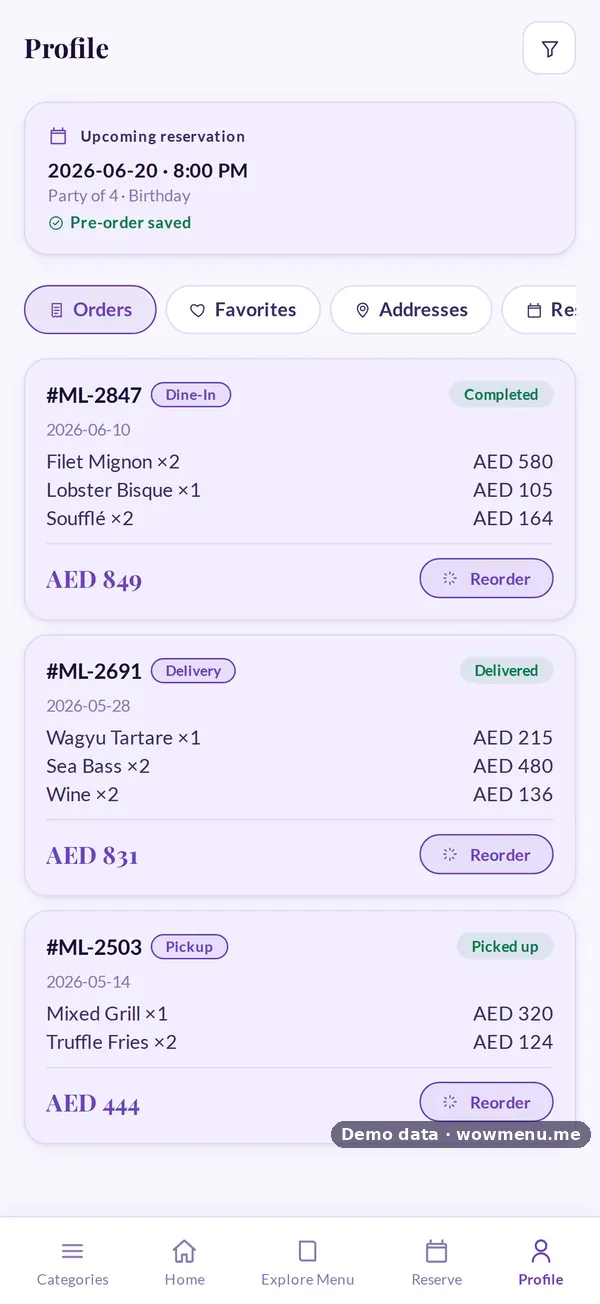
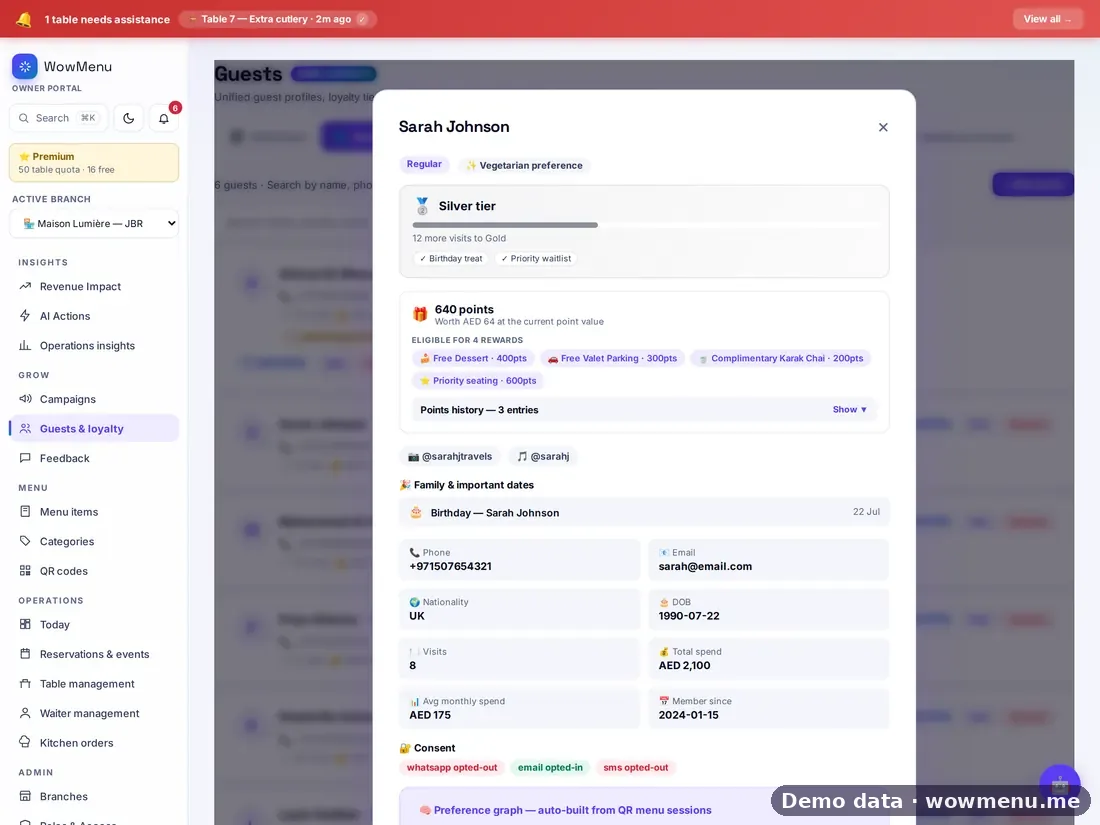
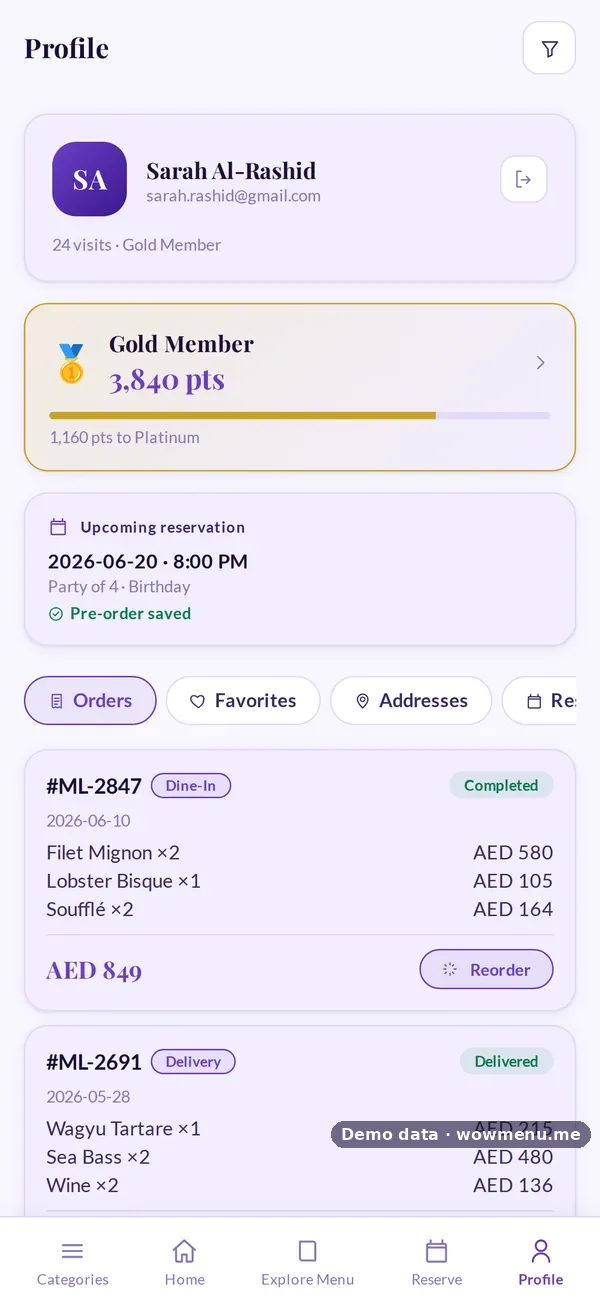
One signed-in guest, one profile across your branches
A guest who signs in has one profile. The owner sees the whole directory with tags, allergies and visit history in one place.

Key benefits
What Restaurant Guest CRM does for your restaurant
A full profile
Contact details, tags, allergies, preferences, favourite dishes, and visit and spend history, shared across your branches.
Behaviour signals
Dessert lover, lapsing, high spender, close to a tier upgrade, weekday-only diner and more, from data you already hold.
Lapse detection against each guest's own rhythm
A weekly regular quiet for three weeks is lapsing. A quarterly diner at three weeks is fine.
Consent, duplicates and import
Marketing consent badges, duplicate detection and merge, and CSV import with field mapping.
How it works
Profiles build themselves
Visits, orders and reservations feed one profile per guest across your branches.
Signals and tags appear
Behaviour signals and automatic tags are worked out from the data you hold.
Your team sees what matters
Allergies and preferences are visible at the table, and a celebrations today view highlights family dates.
You message only who wants to hear
Consent badges show who has agreed to marketing, so you contact the right guests.
Frequently asked
What is in a guest profile?
Contact details, birthday, notes, tags, allergies, food and seating preferences, favourite dishes, visit and spend history, and family dates.
How does lapse detection work?
It is measured against each guest's own rhythm, so a weekly regular who goes quiet for three weeks is lapsing, and a quarterly diner at three weeks is fine.
Is it a machine-learning model?
No. Behaviour signals and lapse detection are transparent and rule-based, worked out from data you already hold.
Can I import my existing guests?
Yes. Import a CSV with field mapping. Duplicate detection and merge help keep records clean.
How many profiles are included?
Up to 2,500 on Growth and 10,000 on Suite.